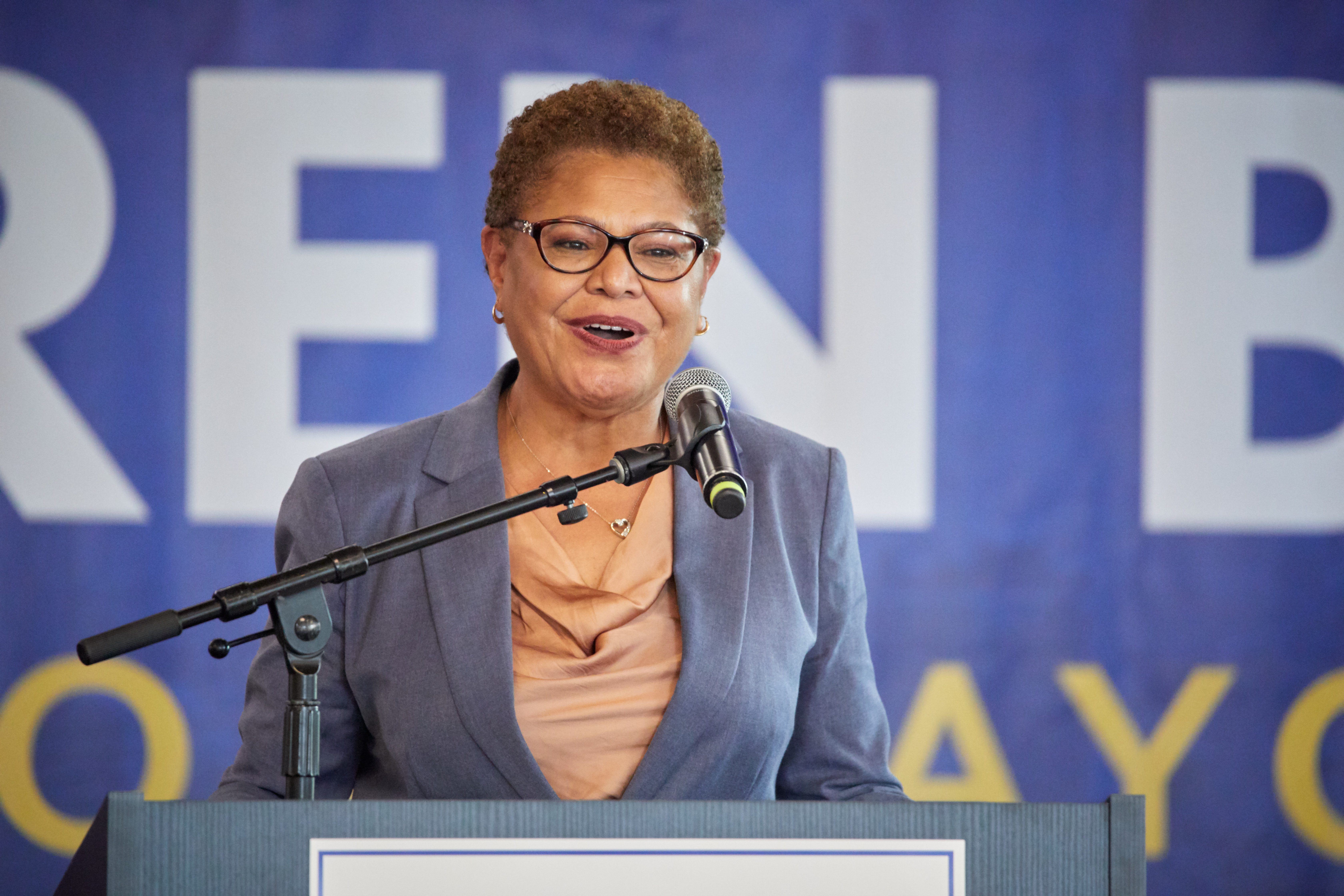
A fabricated poll showing Mayor Karen Bass with a double-digit lead in the Los Angeles mayoral race didn't just fool her campaign and local media. It may have fueled a prediction-market scheme that legal experts say could amount to fraud.
The Associated Press tracked thousands of trades from roughly 20 accounts on Polymarket within six minutes of Bass's campaign posting about the poll on X, The LA Local reported. On Kalshi, the price of a "yes" bet on Bass winning rose from 63 to 65 cents within 15 minutes. On Polymarket, Bass's contract climbed from 61 cents to a peak of 70 cents before the Los Angeles Times exposed the poll as bogus on Monday, Aug. 17. One trader placed a single $6,000 bet on Bass, The American Prospect reported.
"If nothing else, Median Strategies proved the concept that a pump-and-dump scheme is easily transferrable to election prediction markets," David Dayen wrote in The American Prospect.
The poll, published by a group calling itself Median Strategies around Aug. 12, claimed to show Bass leading Councilmember Nithya Raman by nearly 12 points in the Nov. 3 runoff, based on a supposed survey of 560 voters. Bass's campaign promoted it on X before deleting the post. Several local outlets reported the numbers as real.
On Aug. 17, after Los Angeles Times reporter Noah Goldberg pressed the firm for comment, Median Strategies retracted its results and replaced its website with a disclaimer calling the data fabricated.
The Guardian identified 21-year-old recent college graduate Rahil Prakash as the person behind the operation. Prakash told the paper he built the website using AI and was motivated by a polling miss in the Michigan Senate primary. He denied trading on prediction markets.
But the trading activity has drawn scrutiny from legal scholars. Quinn Yeargain, a professor of the law of democracy at Michigan State University, told the Los Angeles Times that if the goal was to affect prediction markets, "at a high level what we're talking about is a lie that is meant to get people to act to their detriment. … We would classically describe that as fraud." Justin Levitt, a law professor at Loyola Marymount University, said both the LA County district attorney's office and the U.S. Department of Justice would have a potential interest in investigating.
No official investigation has been announced.
Mark Baldassare, survey director at the Public Policy Institute of California, said he had never in his career encountered a completely fabricated survey with made-up findings. "It's disturbing. It's a wake-up call for all of us," Baldassare said.
Mindy Romero, director of USC's Center for Inclusive Democracy, rejected the "social experiment" framing, saying reputable researchers do not engage in such practices. Christian Grose, a USC political science professor, warned that polls shape races beyond voter opinion: "Polling can drive outcomes. Favorable polls lead to more fundraising. There's a bandwagon effect."
The American Association for Public Opinion Research condemned the fake polls on Aug. 19, calling them a serious breach of ethics that undermines legitimate polling.
Bass campaign spokesperson Alex Stack said leadership had reviewed the polling memo and decided it was legitimate because "the poll was reported on by multiple news outlets." Raman campaign spokesperson Liz Garcia called the episode "the latest example of an administration that too often struggles to get the basics right."
Kalshi told the Times it did not see a bump in trading around the time of the fake poll's release, a claim that conflicts with the AP's reporting of a two-cent rise. Prakash and Median Strategies both denied any financial motive.
The runoff between Bass and Raman is scheduled for Tuesday, Nov. 3. A recent UC Berkeley poll placed Raman 4 points ahead of Bass. The first debate between the two candidates took place Aug. 19 in Sherman Oaks.