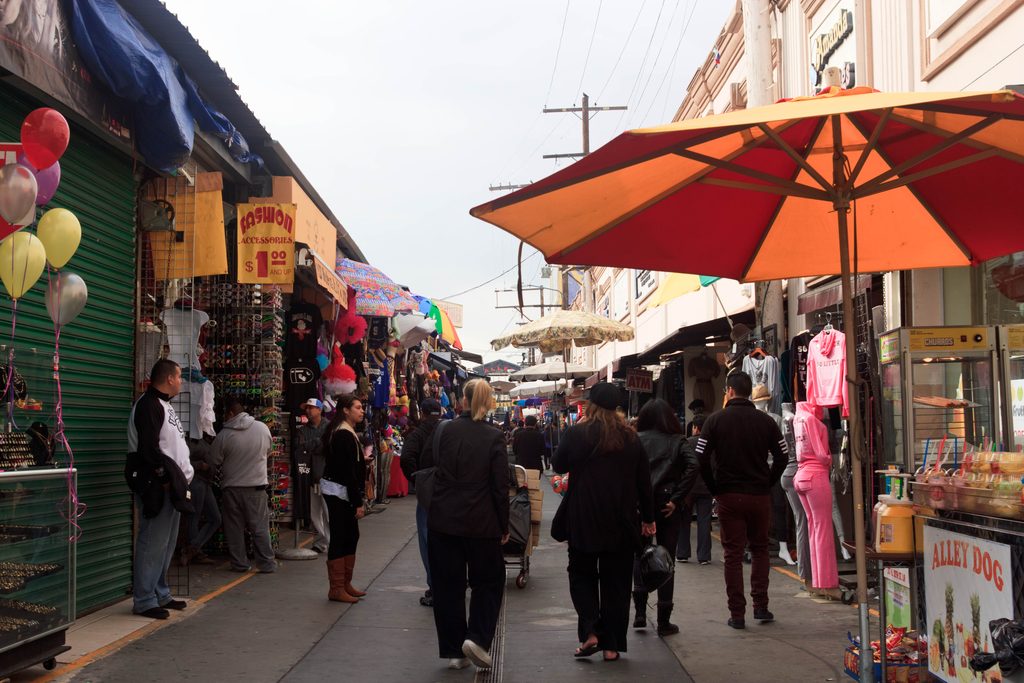
The Fashion District lost an estimated $1.52 million in just two weeks after federal immigration agents raided a garment factory there in June 2025, according to a UCLA study released in July. More than a year later, business owners say the 107-block corridor still hasn't recovered.
The study by UCLA's Latino Policy and Politics Institute found that 59% of surveyed business owners reported sales drops exceeding 50% after the enforcement surge. When interviewed between April and May 2026, 95% of the 75 owners surveyed still reported financial stress.
Regino Tirado has sold women's puffer vests and jackets at V&C Casual in the Stanford Wholesale Mart for more than 25 years. His monthly revenue has fallen from about $25,000 before the raids to roughly $10,000, before paying employees and $5,000 in rent. "After that day, no one wanted to come to the Fashion District," Tirado told The LA Local. "Look, it's empty."
The June 6, 2025, raid on Ambiance Apparel saw federal agents arrest more than 40 workers across multiple facilities, many from the Indigenous Zapotec community, according to the Guardian. The operation became a defining image of that month's enforcement surge, which drove immigration arrests in the greater Los Angeles region to 2,425 in a single month, roughly seven times the figure recorded six months earlier.
The Fashion District is home to more than 4,000 independently owned businesses, and Latinos account for more than 60% of its shoppers, according to the L.A. Fashion District Business Improvement District's annual report. Foot traffic plunged 33% in the week after the raid, and visits to Santee Alley dropped by 50%.
Anthony Rodriguez, who leads the Fashion District BID, told the Los Angeles Times in January 2026, after a second immigration sweep hit the area, that the raids had driven a 37% drop in visits overall. He compared the situation unfavorably to the pandemic, when businesses at least received government support. "These people are on their own," Rodriguez said. "They live from sale to sale, dollar to dollar, day to day, and there is no help coming."
The UCLA researchers, who analyzed anonymized cellphone location data and conducted focus groups with 75 Latino business owners, called the $1.52 million figure conservative. Co-author Ariana Valle, an assistant professor of sociology at UC Davis, noted it counts only formal businesses at fixed locations, excluding the district's many street vendors. Countywide, the study projected approximately $52 million in revenue losses within two weeks, based on modeled assumptions about aggregate foot traffic declines.
The damage has compounded. Joel Galvez and Leonor Torres, who own quinceañera and women's dress shops in the district, told the Los Angeles Times in June that their debt jumped from $20,000 to about $150,000 in the year after the raids. Saturdays, once their busiest days with 50 or more dresses sold per store, now yield about 10 sales each.
Tirado's wholesale buyers from Mexico, Costa Rica and Colombia used to visit twice a month. They now come every other month, and sales have increasingly moved to WhatsApp transactions. Even a burst of World Cup jersey orders couldn't push him back to his pre-raid baseline.
Rodriguez said foot traffic remains "at the mercy" of rumors, sometimes false, of federal enforcement operations circulated in group chats among merchants. A national enforcement surge in late June 2026 that detained more than 10,000 people in five days reignited fears that had slowly begun to ease, sending businesses shuttering at a moment's notice, with "people literally running from their stores."