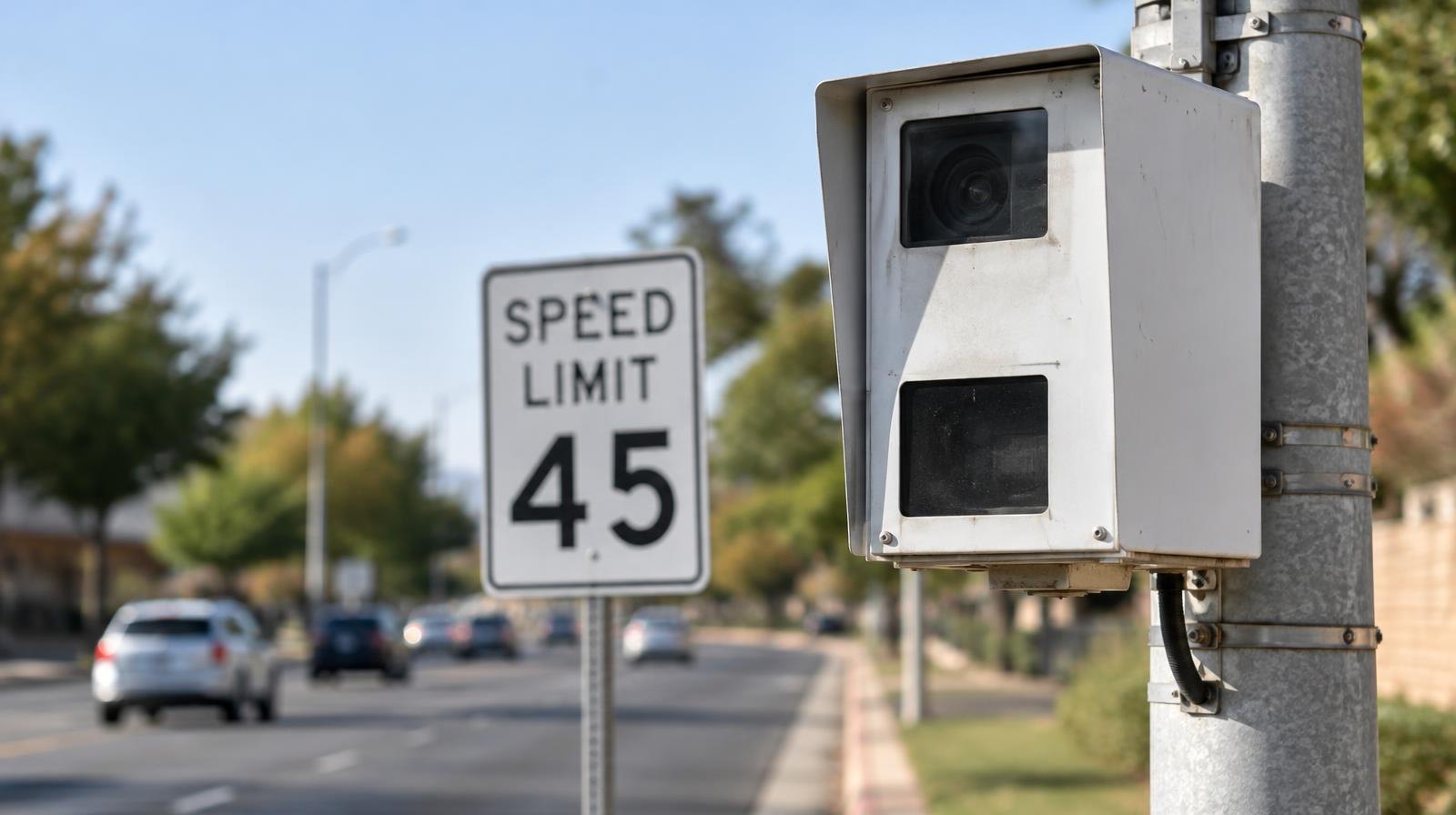
Los Angeles will begin activating automated speed cameras across the city on Oct. 26, launching a program that will eventually place 125 systems on the corridors where speeding kills the most people.
Laura Rubio-Cornejo, general manager of the Los Angeles Department of Transportation (LADOT), announced the Speed Safety Systems Program at an Oct. 1 press conference at Kingsley Elementary School in East Hollywood, where crews installed the city's first camera. LADOT expects all 125 systems to be running by the end of 2026, according to the agency's program page.
The cameras are spread across all 15 City Council districts. Most districts will get eight. Districts 4, 6, 8, 9 and 10 will each get nine, Spectrum News reported.
What drivers need to know
Each camera triggers only when a vehicle exceeds the posted speed limit by 11 mph or more. The system photographs the rear license plate only and does not capture the driver's face. Under state law, that data cannot be shared with law enforcement unless a court issues a subpoena, and photos must be deleted within five days if no violation occurred.
Every new camera starts with a 60-day grace period. During that window, speeding drivers receive written warnings, not fines.
After the grace period ends, a first offense at 11 to 15 mph over the limit still draws a warning. Repeat violations in that range start at $50. Driving 16 mph or more over the limit triggers a civil citation starting at $100. LADOT publishes the full fine schedule at LAspeedsafety.org.
Fine revenue cannot flow into the city's general fund. The money must go toward street-safety infrastructure, according to Streetsblog LA.
Why these locations
LADOT selected corridors using crash history, speeding data and proximity to schools, senior centers and other high-injury zones. Community feedback and City Council offices also shaped the final list.
In Council District 5, cameras were installed by Oct. 12 at La Brea Avenue and First Street, Fairfax Avenue and Clinton Street, Melrose and Hayworth avenues, and La Cienega and Pico boulevards, Spectrum News reported Oct. 12. In District 11, eight corridors including Venice Boulevard, National Boulevard and Vista Del Mar are slated for cameras, with seven of the eight sites under construction as of Oct. 12, according to the Westside Current.
All camera locations will display signs noting the speed limit and that it is camera-enforced.
The safety case
Excessive speed contributed to roughly 20% of the city's fatal vehicle collisions in 2024, according to LADOT. In 2025, 290 people died in traffic incidents in Los Angeles, more than the city's homicide total that year, according to LAPD data.
Councilman Hugo Soto-Martinez, who represents Hollywood, called the cameras the biggest advancement in Los Angeles traffic safety in decades at the Oct. 1 announcement.
U.S. Rep. Laura Friedman, who authored the enabling legislation as a state assemblywoman, was blunt at the same press conference. "These are not gotcha tickets," she said, according to Streetsblog LA. "If you're going more than eleven miles an hour over the speed limit in a school zone, and if you've done it more than once, shame on you."
The program is authorized under California Assembly Bill 645, signed by Gov. Gavin Newsom in October 2023. The law allows Los Angeles, San Francisco, San Jose, Oakland, Long Beach and Glendale to run speed-camera pilots through Jan. 1, 2032. LADOT must submit a safety and economic evaluation to the state legislature at the end of the pilot period.
San Francisco saw more than a 70% decline in speeding after activating its cameras, according to LADOT. Damian Kevitt, executive director of the advocacy group Streets Are for Everyone, said San Francisco also experienced a 42% drop in traffic fatalities in 2025.
Drivers can check the full location list at LAspeedsafety.org before Oct. 26.